Overview: As the UK embarks on its most ambitious nuclear programme, we sit down with Andrew Breeze, ASD’s BD Manager for Nuclear, to discuss what the government’s nuclear programme with a new framework means for the supply chain.
The UK’s Nuclear Moment: Ambitious Plans and New Opportunities
At the start of 2026, the UK Government set out one of its most ambitious nuclear programmes to date, supporting its target to deliver up to 24 GW of nuclear capacity by 2050. The announcements were significant. A £14.2 billion commitment to Sizewell C in Suffolk, £2.5 billion planned for first Small Modular Reactor (SMR) project in Wylfa in North Wales and, the publication of the Advance Nuclear Framework – a government backed pipeline designed to open the door to privately led advanced nuclear projects across the UK.
Together these announcements signal the government’s commitment to accelerate investment, strengthen energy security and transform the energy infrastructure landscape for the long term. They also highlight new opportunities beyond energy production: North Wales, home to the proposed Wylfa SMR, is set to host the UK’s first AI Growth Zone. Nuclear energy’s predictable, high-capacity output and low-carbon lifecycle make it increasingly attractive for powering large-scale data centres, positioning the sector as a key enabler for the next generation of technology infrastructure.
For anyone involved in the nuclear supply chain, it marks the beginning of what could be a new era for nuclear in Britain. With Hinkley Point C under construction and Sizewell C moving forward, alongside growing pipeline of advanced and privately led projects, it becomes clear Britain’s nuclear ambitions will rely heavily on capabilities and expertise of its domestic supply chain. It’s a very exciting time for the nuclear industry. The government’s ambition to become a clean energy superpower represents a real opportunity for the UK workforce and for suppliers who are ready to step up.
We spoke to Andrew Breeze, Nuclear BD Manager at ASD on recent developments and what the new framework demands from the supply chain.
Q: The government has published its Advanced Nuclear Framework. From a supply chain perspective, what does this actually mean?
Andrew: I think this framework gives the entire nuclear supply chain the reassurance to invest further in the skills, processing capability and quality standards that these projects demand. Making these projects come to life will rely on experienced UK supply chain partners who understand highly regulated environments – and that’s where we add value.

For suppliers like ASD, the opportunity is clear. When existing suppliers and contractors assess potential partners, they are looking for proven capability – reliable partners that can operate to nuclear standards, with experience from R&D and design through to build, operations and decommissioning. But Nuclear Safety is what underpins everything. A true safety-first culture isn’t a tick-box exercise – it has to be built into everything you do, every day.
Q: Andrew you mentioned Nuclear Safety. What does that look like in practice and why general industrial capability is not enough?
Andrew: The reality is that Nuclear Safety doesn’t simply mean following procedures. It encompasses how materials are specified, how they are handled, how contamination is prevented, how the quality is tested and verified at every stage and how integrity is demonstrated. Basically every product or material supplied for a nuclear project has a chain of custody, traceability and documentation which go far beyond other industrial sectors would consider as standard.
At ASD, we’ve built our nuclear offering around five key principles: nuclear safety as the absolute priority, CFSI management – that’s Counterfeit, Fraudulent and Suspect Items, cross-contamination control, quality testing, and integrity in every transaction. These are our operational realities. We have structured testing programmes. We maintain the documentation and traceability that nuclear customers require as standard. And we’ve done this successfully on a number of nuclear projects – from waste decommissioning storage boxes and embedment sleeves for Hinkley Point C, to HVAC components for nuclear mechanical and electrical services contractors.
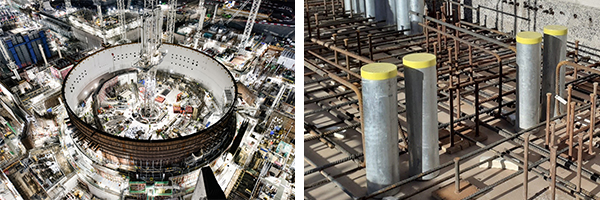
I strongly believe that track record matters enormously, and when Sizewell C moves into full construction, and when Wylfa begins its journey from site preparation to reactor deployment, contractors will be looking for suppliers who have already demonstrated they can deliver to nuclear standards.
Q: Looking ahead, what does ASD see as the key challenge and opportunity for the nuclear supply chain over the next decade?
Andrew: The challenge is scale, without a question. The UK’s existing nuclear supply chain has been operating at a relatively modest level for years, supporting operations and decommissioning work. With this new ambitious programme, multiple projects are opening up so the picture is clear: The UK isn’t just delivering a handful of nuclear projects, it’s building a programme of national scale that will last decades. This will require investment into infrastructure, people and systems that make nuclear supply possible.
The opportunity is equally significant. For ASD, it’s not about seizing something new, it’s about growing an existing commitment. We have the relationships, the infrastructure, the expertise and the track record already in place. What the next decade demands is that we scale that commitment alongside the programme itself: supporting the contractors and fabricators who are working on Hinkley Point C today, positioning ourselves for Sizewell C and Wylfa as they move through their construction phases, and being ready for the broader pipeline of advanced projects that the framework will open up.
The message is simple: We’ve been here before. We’ve delivered to nuclear standards. We know what it takes. And we’re committed to doing it again – at bigger scale, across more projects, and with the same commitment and integrity that nuclear work demands.
Nuclear safety isn’t a checkbox. It’s a culture. And at ASD, it has been part of how we work for years.
To find out more about our capabilities or to discuss how we could support your nuclear project get in touch with our team.