Overview: Steel and metal supply chains are becoming harder to predict, and procurement teams are increasingly expected to manage that uncertainty without slowing projects down. The challenge is no longer just about securing supply, it’s about how much risk sits behind it.
This article looks at what that means in practice, and why access to production, depth of stock, and integrated processing are starting to matter less as “nice-to-haves” and more as part of how resilient supply chains are actually built.
Steel Supply Chain Resilience in 2026: What UK Procurement Teams Need to Know
Steel and metal supply sits behind almost every major procurement decision, whether that’s construction, energy, defence, or manufacturing. For a long time, the expectation was straightforward: the right material turns up, where and when it’s needed, and everything else follows from there. That assumption is starting to wear thin.
Procurement teams are now being asked to deliver certainty in a system that doesn’t behave as predictably as it used to. And that shift is subtle, but important. It’s not just that disruption happens more often, it’s that it’s becoming part of the baseline.
Over the past few years, supply chains haven’t just been disrupted, they’ve been reshaped. Geopolitical tensions, pressure on global logistics, and price volatility have all played a role. But taken together, they point to something bigger: instability is no longer the exception.
Which means the question has changed. It’s no longer “how do we respond when disruption happens?” It’s “what does a supply chain look like when disruption is expected?”
Rethinking Supply Chain Fragility in 2026
The current environment didn’t arrive overnight. It’s the result of several overlapping shocks – post-pandemic backlogs, the war in Eastern Europe, shifting trade policies, and ongoing tariff changes. Each one forced procurement teams to adjust.
But taken together, they’ve done something more fundamental: they’ve exposed how dependent many supply chains are on stability that no longer exists. In practical terms, most teams are already feeling this:
- Lead times that move, sometimes without much warning
- Spot prices that don’t hold long enough to plan around
- And decisions that carry more weight, because getting them wrong can mean delays, substitutions, or reworking entire programmes
That pressure increased again on 1 July 2026, when the UK’s new steel strategy significantly cut tariff-free import quotas and introduced a tariff on anything imported above those limits. For businesses that rely on imported steel, this isn’t just another policy update – it’s tightening both cost and availability at the same time.
And it leaves less room for error. At that point, resilience stops being a reactive capability and starts becoming something more structural. It’s less about how quickly you recover, and more about how exposed you are in the first place.
Where Resilience Actually Starts
A lot of supply chain conversations focus on what happens at the point of purchase – pricing, availability, lead time. But in steel, much of the risk sits further upstream.
Most distributors operate at arm’s length from production. Material is sourced, traded, moved, and eventually delivered. By the time it reaches the end user, the complexity behind it is largely hidden. That works, until it doesn’t. Because when availability tightens globally, or demand spikes in certain grades or formats, access to production starts to matter more than access to stock lists.
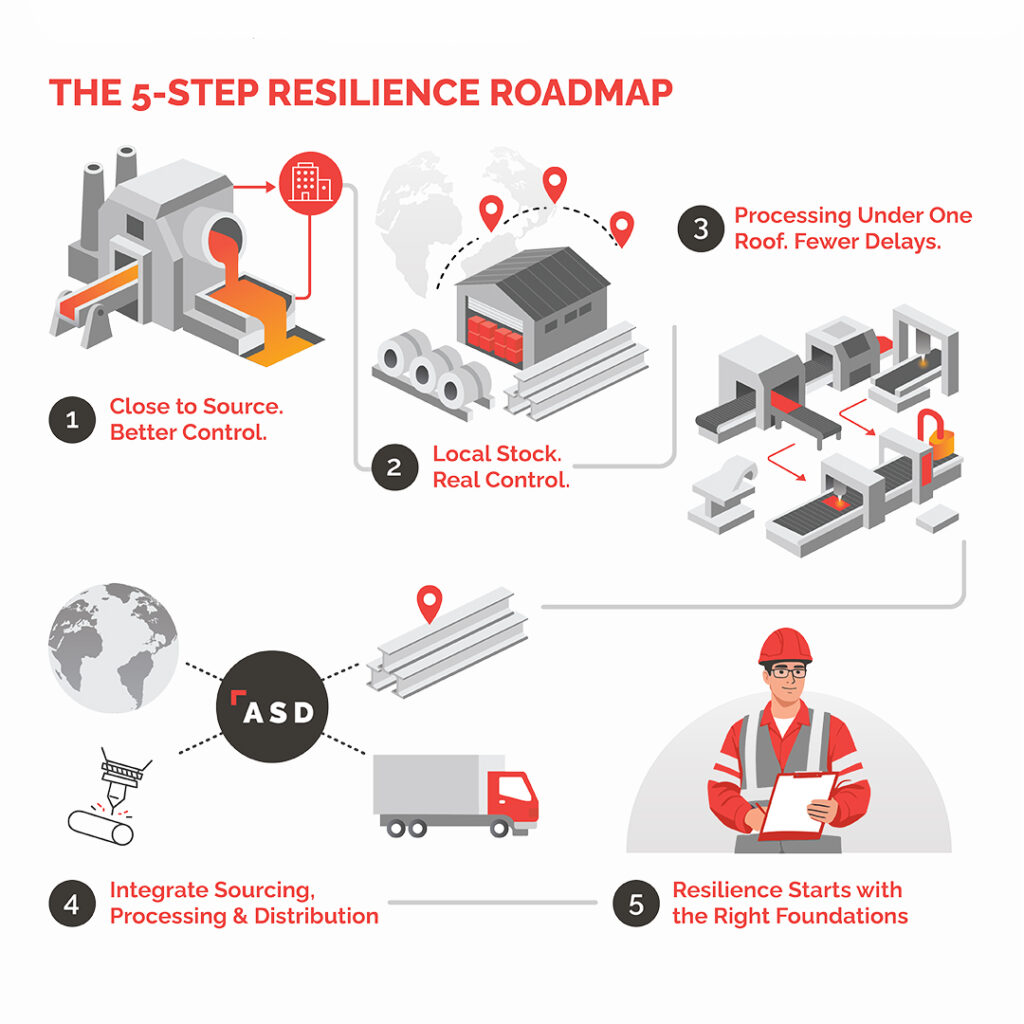
At ASD, that upstream visibility is different. As part of the Hierros Añón Group, we’re connected directly to six production mills across Spain and France, alongside a wider supplier network.
What that changes isn’t just availability, it’s control. When conditions shift, having direct production access allows for a different kind of response. It reduces dependency on fragmented supply routes and gives more flexibility when certain products come under pressure. It doesn’t eliminate risk, but it does change where it sits.
Stock Is No Longer Just a Buffer
Stock has always played a role in smoothing supply. But in the current environment, it’s taken on a slightly different meaning. When lead times stretch or imports tighten, stock isn’t just a fallback, it becomes part of how projects stay on track in the first place.
At ASD, we hold over 70,000 tonnes across 12 UK sites. The scale matters, but not just in terms of volume. What matters more is how that stock is positioned and how quickly it can be mobilised. For procurement teams, that tends to show up in a few ways:
- Greater flexibility when timelines shift
- Less need to accept alternative grades or specifications
- The ability to plan call-offs with more confidence
- And some insulation from short-term price or availability swings
In other words, stock starts to act less like a safety net and more like a form of control.
The Hidden Risk in Processing
One area that doesn’t always get much attention is what happens between raw material and final installation. Laser cutting, profiling, forming, and other forms of processing – these steps are often handled by different parties, sometimes in different locations. Under normal conditions, that’s manageable. But each additional handover to a new supplier introduces another dependency.
And when timelines tighten or supply becomes uncertain, those dependencies don’t stay neutral, they start to add friction. Bringing those processes together under one roof doesn’t just simplify logistics. It reduces the number of variables that need to go right at the same time.
At ASD, in-house capabilities – from laser and water jet cutting through to forming and decoiling allow sourcing, processing, and delivery to be managed as a single flow rather than a series of disconnected steps. For more complex programmes, Total Metals Management offering (TMM) extends this further, coordinating materials, processing, and delivery schedules through one managed structure.
For procurement teams, that usually translates into something quite simple: fewer moving parts, and fewer surprises.
Location Still Matters – More Than It Used To
There’s a tendency to think of supply chains in global terms. And that’s true, up to a point. But when disruption hits, what matters just as much is proximity. Having stock in the right country isn’t enough. It needs to be in the right place, close enough to respond when plans shift or timelines compress.
With 12 sites across the UK, ASD’s model is built around that idea, keeping material within reach of where it’s actually needed. Because when supply is under pressure, local availability stops being a convenience. It becomes one of the few things you can still control.
Quality and Continuity Aren’t Separate Conversations
In high-integrity sectors, quality and traceability are non-negotiable. That part hasn’t changed. What has changed is how closely that links to continuity. Knowing where material comes from, how it’s processed, and how it moves through the supply chain isn’t just about compliance, it’s about reducing uncertainty.
ASD’s systems are built around that principle: audited processes, accredited sourcing, and full traceability from origin to delivery. Alongside that, our ISO 22301 Business Continuity certification provides a more formal structure behind how disruption is managed.
But in practice, it comes down to something more straightforward: planning ahead, understanding requirements properly, and removing avoidable risk before it shows up.
A Different Way to Think About Resilience
There isn’t a single model for building a resilient supply chain in 2026. Different sectors, projects, and risk profiles all require different approaches. But the direction of travel is becoming clearer:
- Fewer dependencies.
- Closer alignment between sourcing and processing.
- More visibility into where material actually comes from.
- And, increasingly, working with partners who can absorb some of that complexity rather than pass it down the chain.
The companies that move early on this won’t eliminate disruption. But they will find themselves operating with a level of certainty that others struggle to maintain. And in the current environment, that difference tends to show up quickly.
Let’s Strengthen Your Supply Chain
If you’re reviewing how your supply chain is set up, whether for an upcoming programme or longer-term planning, it’s worth having that conversation early with our team.
Because by the time disruption shows up, most of the important decisions have already been made.