
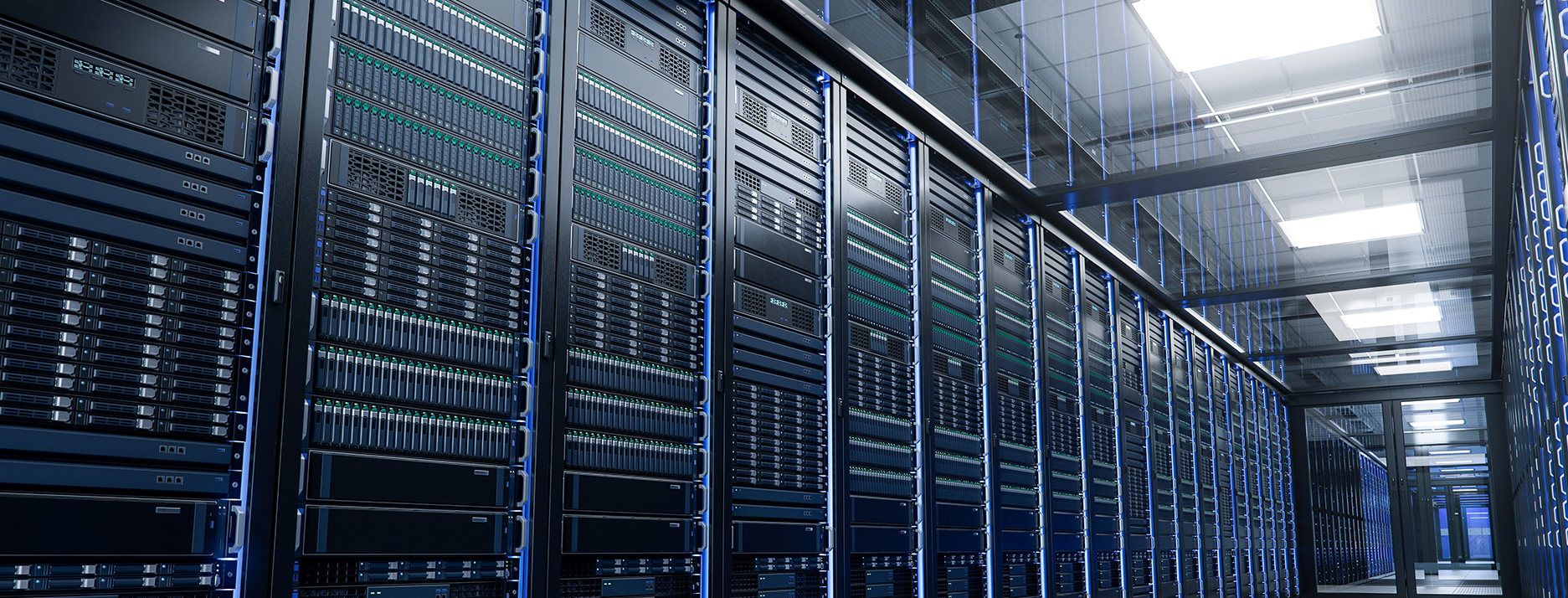
The boom in Artificial Intelligence has seen an explosion in the planning and construction of new data centres (DC) across Europe, with another 100 data centres scheduled to be built in the UK alone over the next few years.
The data centre sector is a global game, and ASD Westok's technical advisory engineers regularly engage on a confidential basis with a variety of UK, Irish and mainland European engineers and contractors on the design of single-storey and multi-storey data centre projects.
ASD Westok’s technical advisory engineer James Way has considerable experience providing design guidance on DC schemes as part of Westok’s free design service to industry. Westok’s Design Team Manager John Callanan recently assisted with the SCI publication P449 – Best Practice for Designing Low Embodied Carbon Steel Buildings1.
John sat down with James to discuss the challenges and solutions relating to the sustainable design of data centres in the AI era.
John: Minimising carbon emissions is a significant challenge for our industry; however it also offers opportunities. What's the real challenge when it comes to data centre construction and what part can we play at Westok to meet this challenge head-on?
James: You’re right to say that in the context of the climate crisis, the delivery of the next generation of data centres presents a major challenge to industry.
Data centres are significant sources of carbon - both operational and embodied - within the structure. Whilst circa 80% of the whole life carbon of a data centre is currently operational, as grids decarbonise across the Europe, the focus will increasingly fall on embodied carbon within the mechanical, electrical and plumbing (MEP) and structural materials.
Strategies to minimise the embodied carbon of data centres are therefore crucial. This is where our expertise comes in. We have worked on numerous projects across the UK, Ireland and mainland Europe, and we have seen first-hand how Westok cellular beams deliver significant carbon savings and operational benefits at both floor and roof level in DC schemes against alternatives, particularly heavy UB and IPE sections and trusses.
John: So drawing from your expertise how do you design structures, particularly data centres, that won't be obsolete in a few years?
James: With server technology rapidly changing and servers typically replaced every three years, a sensible degree of operational flexibility should be built into the primary structure, without incurring a cost or carbon penalty.
Westok cellular beams provide a highly efficient solution for the larger clear spans required to maximise rack count and medium to long-term flexibility. Spans for Westok-designed data centre with cellular beams at data hall/floor level typically range from 10 – 18m. The use of cellular beams in external gantries to multi-storey DCs is another more recent development worthy of consideration.
At roof level, span ranges vary considerably, depending on the form of the roof, i.e. clear-span rafters, rafter and spine beam arrangements, with pitched and curved variations quite common.
I am frequently requested to review value engineering solutions also, particularly where deep trusses are initially specified.
In each case, the focus is on generating cost and carbon savings by offering attractive lightweight design solutions, whilst addressing other key design constraints, such as deflection and fire for example.
John: Everyone is looking to reduce weight and carbon. How do Westok cellular beams compare to traditional solutions?
James: Optimally designed ribbon-cut cellular beams have been shown to be the most weight-efficient steel profile for office loadings in the span range 9 - 18m2. Data centre loadings are significantly higher, with the first generation typically being designed for 15 kN/m², and we are now seeing some imposed loads up to 25 kN/m² for the latest generation of AI data centres. That said, the same general weight and carbon saving principles apply, as the imposed load increases.
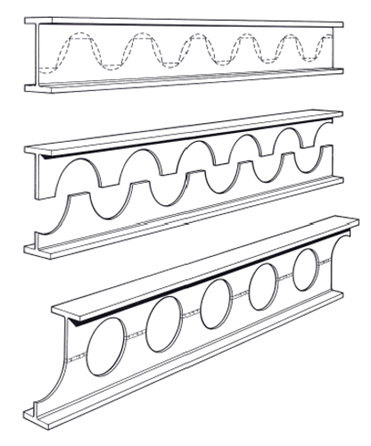
Image: Westok ribbon-cut manufacturing process
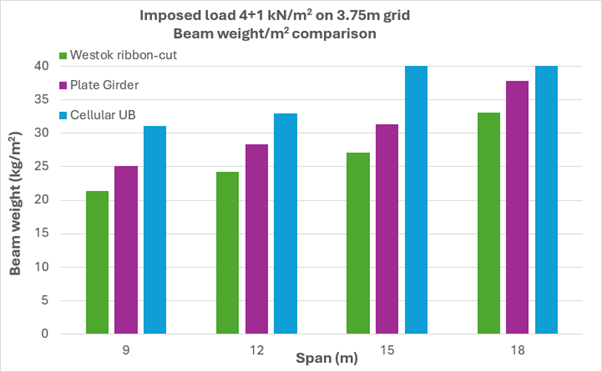
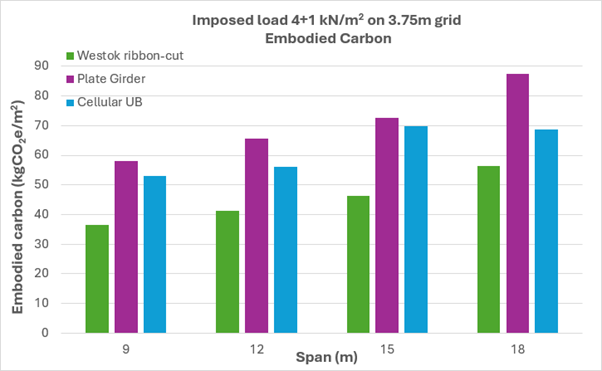
Images: Weight and carbon savings using Westok ribbon-cut beams
John: The combination of high imposed loads and a desire for clear spans must present a challenge. Are there any strategies to address this?
James: The client’s requirements for flexibility in the number and future location of server racks is an important consideration. To maximise flexibility the server load will typically be applied over the full floor area.
However, if it is deemed acceptable to assume that the server rack position will remain unchanged for the life of the structure, then locally high patch loads can be applied with a lower generalised data hall loading between them. This can significantly reduce the overall design load and, therefore the resulting weight and embodied carbon of the supporting beams.
John: As we know, cooling drives a major share of a data centre’s carbon footprint. So how can smarter structural design, such as the use of Westok cellular beams, make cooling more efficient and sustainable?
James: A high-level study by Arup3 has found that 70% of the embodied carbon and 88% of the whole life carbon is a result of the mechanical, electrical and plumbing (MEP) systems.
Operationally, efficient cooling is clearly critical, and this is conventionally achieved using circulated air, either at ambient temperature or water cooled. The use of Westok cellular beams with regular cells across the beam, maximises the efficiency of the cooling system, with large cells presenting minimal obstruction to the free flow of air through the data halls.
Cells can also be used to facilitate the efficient layout of ducts, cabling and pipework, a benefit likely to have particular value for the next generation of immersion cooled servers.
John: What is your advice for design teams working on a DC project today?
James: It is important to consider cellular beam options as early as possible in the design process. Cell diameter, cell spacing and particularly beam depth, are all variable factors that can be tailored to maximise carbon savings. These key drivers should therefore not be 'locked-in' prematurely, without careful consideration.
Westok engineers have experience reviewing multiple grid layouts with varying beam depth and cells size options. Involving us at the early stages allows design teams to home in on the most appropriate solution for their DC project, including external gantries also.
Westok cellular beams are typically pre-cambered at no additional cost, another important consideration when reviewing serviceability aspects.
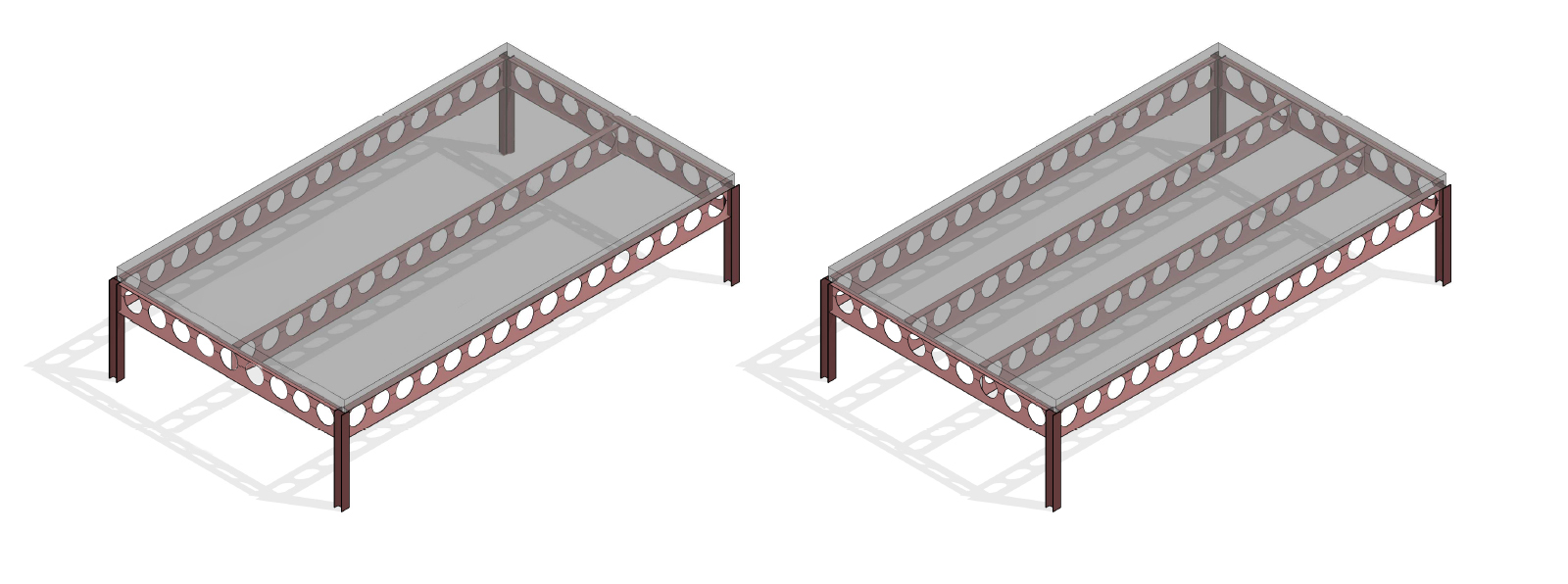
Image: Westok secondary and primary beam grid options
John: Structural steelwork seems like the obvious choice for data centres, but isn’t all steel the same from a carbon perspective?
James: Steel is a structurally efficient material that will be the natural choice for the structural frame of data centres in many countries.
The carbon content of steelwork varies significantly, depending on the production method employed. Primary steel from the blast furnace production route typically has emissions of around 2500 kgCO₂e/t, whereas electric arc furnace (EAF) fed with scrap steel has emissions potentially as low as ca. 300 kgCO₂e/t.
John: So why not just specify EAF steel for everything then?
James: There’s a couple of key points here which we regularly discuss in our CPD seminars with engineers and contractors.
Whilst we can realistically source EAF parent section for Westok beams on a discreet project basis - as we have done on a number of occasions in the past - the wholesale direct specification of EAF steel is discouraged due to constraints on the global availability of scrap steel4 .
Furthermore, from a practical sourcing perspective, only certain construction products such as rolled section UB and IPE are available day to day from the EAF route without cost and programme implications.
The emphasis is rather on leaner design strategies that promote carbon reduction by taking advantage of lighter weight design solutions, such as Westok's ribbon-cut cellular beam.
Steelwork specifications requiring a percentage of the project steelwork to conform to internationally recognised standards, such as the Responsible Steel International Production Standard5 promote the decarbonisation of all steel-making processes.
Westok can readily supply ribbon-cut beams that meet 'lower carbon steel' Progress Level 2 to this standard without cost penalty.
Strategies to adopt leaner designs have been explored in a piece published in The Structural Engineer6.
John: There's a lot of talk about circular economy. Can we actually take advantage of reused steel sections in data centres?
James: The direct reuse of steel sections recovered from existing structures is increasingly being considered as a lower-carbon alternative to 'virgin' steel. Whilst unlikely to be applicable to the highly loaded data halls, lower loaded areas may be suitable locations for reused steel.
Westok has successfully undertaken the ribbon-cutting of a variety of reused steel sections on two recent projects, demonstrating that the cellular beam material and service benefits discussed above can also be achieved with reused sections.
John: What's your final message to design teams working on data centre projects?
James: With 100 data centres planned for the UK alone in the coming years, and many more in Ireland and mainland Europe, the scale of the challenge is unprecedented. Every design decision made today needs to deliver both immediate carbon savings and long-term flexibility as technology evolves – whether that is accommodating next-generation cooling systems or increased rack densities we haven't even anticipated yet.
ASD Westok can assist design teams to meet the challenge of reducing the impact their data centre projects have on the environment. We work confidentially with teams at the earliest stages to optimise solutions that future-proof your project.
For a confidential conversation, get in touch today.
James Way – james.way@asd.ltd
John Callanan – john.callanan@asd.ltd
References:
- https://steelconstruction.info/Sustainability#Lever_1_Design_efficiency
- https://asd.ltd/westok/lean-design/
- https://www.arup.com/insights/circular-thinking-for-data-centres/
- https://www.istructe.org/resources/guidance/the-role-of-scrap-in-steel-decarbonisation/
- https://www.responsiblesteel.org/standards
- https://www.istructe.org/journal/volumes/volume-100-(2022)/issue-4/viewpoint-time-to-be-lean/